
Building AI Agents for Your Business
Module 1 · Module 1 — AI agents: from assistant to autonomous coworker · Lesson 1 of 1
AI agents: from assistant to autonomous coworker
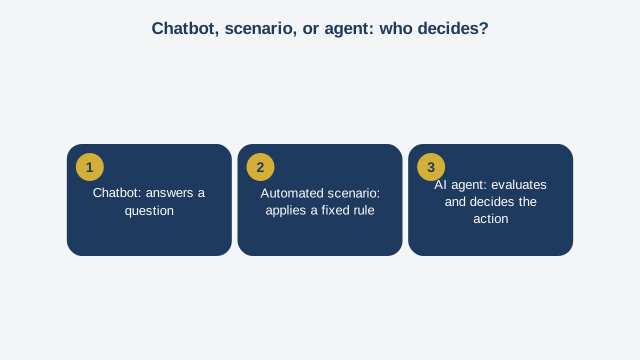
Welcome to this course on A.I. agents — Artificial Intelligence agents — for your business. Before we build anything, we need to clarify a word that gets thrown around a lot right now: "agent." Many people call any tool that uses artificial intelligence an "A.I. agent." That's not accurate, and the mix-up is costly: it pushes companies to pay for a complex agent when a simple tool would have worked, or the opposite — to underestimate a need that truly required autonomy. Let's start with the simplest case: a chatbot. A chatbot answers a question. You type "what are your hours," it replies "we're open from eight a.m. to six p.m." It doesn't do anything else. It checks nothing, changes nothing, triggers no action behind the scenes. It's a conversation, not an execution. Next is the automated scenario, also called classic automation. You've probably already practiced this with a tool covered in a no-code automation course. An automated scenario follows a fixed rule: "if a new message arrives in this mailbox, copy it into this spreadsheet, and send a notification." Already very useful. But the rule is written in advance, hard-coded, and the scenario never really "thinks" — it just applies. And then there's the autonomous A.I. agent, the subject of this course. An agent goes further than a scenario: it observes a situation, it consults a language model — like Claude or ChatGPT — to decide what to do based on context, and it executes the resulting actions itself. Take the customer-message example again. An agent reads the message and figures out whether it's a complaint, a quote request, or a simple question. It checks available stock if needed, drafts a suitable reply, and updates a tracking sheet if needed — all without a human having written in advance "if the customer says exactly this, reply with exactly that." The key difference is decision-making. A scenario applies a rule. An agent evaluates a situation and picks one action among several possibilities, relying on artificial intelligence to interpret what couldn't be predicted in advance. Why does this distinction matter so much for your business? Because an agent costs more to build and run than a plain scenario, and because it introduces a different kind of risk: it can make a wrong decision, whereas a well-written scenario never gets its rule wrong — it just applies it, even if the rule itself was poorly designed to begin with. The right question to ask, for every task you want to automate, is this: does this task need a real decision that varies with context, or does a fixed rule cover nearly every case? If a fixed rule is enough, an automated scenario is simpler, cheaper, and more predictable. If the situations are too varied to be covered by rules, that's where an agent becomes useful. In the modules ahead, we'll learn to spot exactly these situations inside your own business, then design the architecture of the agent that answers them.
Free preview, no account needed — the rest of this module and the following modules unlock after enrolling.
Convinced? Enroll to unlock the full course.
See pricing