
Advanced AI Agent Architecture — Multi-Agent Orchestration
Module 1 · Module 1 — Beyond the single agent · Lesson 1 of 1
Beyond the single agent
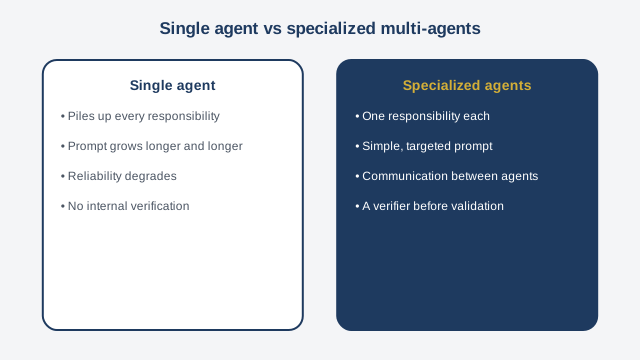
Welcome to this course on advanced AI agent architecture. If you're arriving here after completing "Building AI Agents for Your Business," you already know how to tell apart a chatbot, an automated scenario, and an autonomous AI agent. You remember the central principle: a scenario applies a fixed rule, while an agent evaluates a situation and chooses an action among several possibilities itself, relying on a language model to interpret what couldn't be predicted in advance. This course does not revisit those fundamentals — it picks up from the point where a single agent, however well designed, stops being enough. Let's take a concrete example to see exactly where that limit sits. A company built a single agent to handle customer complaints: it reads the message, identifies the type of problem, proposes a solution, and updates a tracking sheet. As long as volume stays low and cases stay simple, this agent works fine. But the day the company also wants that same agent to check available stock, review the customer's full history, propose a refund in certain cases, and always write in the right tone, a single agent starts stacking up too many different responsibilities inside one prompt. The risk isn't that it fails immediately — it's that it becomes less and less reliable as more instructions pile up, because it has to hold everything in mind at once. That is exactly the signal telling you it's time to move to a multi-agent architecture: several specialized agents, each responsible for one part of the work, collaborating with each other rather than one generalist agent trying to do everything. One agent focuses on reading and classifying the complaint. A second checks stock and customer history. A third drafts the final response. Each does one thing, and does it well, because its prompt stays simple and focused. One caution, though: orchestrating multiple agents is never free. It adds technical complexity, extra processing time — since agents must pass information to one another — and higher cost, since each agent makes its own calls to the language model. So the question to ask yourself is never "can I build a multi-agent system?" but "does the real complexity of this task justify splitting it across several specialized agents, rather than sticking with one well-designed single agent?" Three signals generally indicate that a single agent has reached its limit. First, its prompt becomes so long and so loaded with conflicting instructions that it starts forgetting some of them. Second, the task involves several steps of a very different nature — for example analyzing, then verifying external data, then writing — each of which demands a different kind of reasoning. Third, you need one step to check another step's work before approving it, which a single agent cannot reliably do on itself. In the modules ahead, we'll learn to design these specialized roles precisely, organize their communication, give them shared memory, and supervise the whole system like a real production setup — not an experiment.
Free preview, no account needed — the rest of this module and the following modules unlock after enrolling.
Convinced? Enroll to unlock the full course.
See pricing