
Building Your First Chatbot from Scratch
Module 1 · Module 1 — What a Chatbot Can (and Cannot) Do · Lesson 1 of 1
What a Chatbot Can (and Cannot) Do
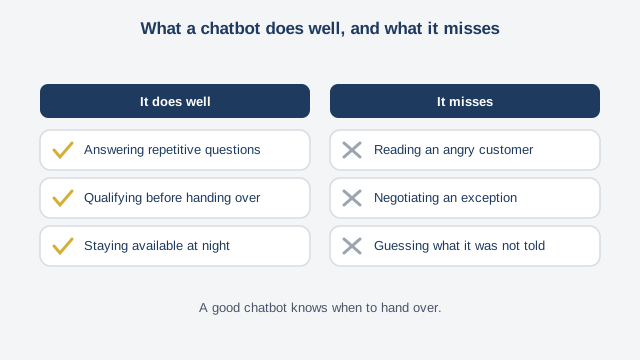
Welcome to "Building Your First Chatbot from Scratch." Before building anything, let's start with a word that gets used everywhere but rarely gets properly defined: chatbot. A chatbot is a program that simulates a conversation with a user, usually through written messages, on a website or a messaging app like WhatsApp. There are two broad families of chatbots, and confusing the two is the first mistake that sinks a project. The first family is the scripted chatbot. It follows a decision tree: the user clicks a button or types a specific keyword, and the chatbot replies with a pre-written message. It's predictable, reliable, and easy to test — but rigid: step outside the planned script, and it understands nothing. The second family is the chatbot connected to generative artificial intelligence. It understands more natural language and can rephrase things, but it can also get things wrong or invent an answer that sounds right without being right — what's called a hallucination. We'll come back to this second family in detail in Module 6. Now, the most important question in this whole module: what can a chatbot actually do today for a small or medium business? It can answer frequently asked questions instantly — hours, prices, availability. It can qualify a request before handing it to a human, by asking two or three sorting questions. It can take a simple order, with limited options. It can also run twenty-four hours a day, seven days a week — something no single employee can do alone. But a chatbot cannot do everything, and that's exactly where most projects fail. It cannot handle an emotionally charged complaint with the same tact as a trained human. It cannot reliably improvise an answer to a completely off-topic question without risking saying something wrong. And it never fully replaces a human on complex or sensitive cases — we'll cover how to organize that handoff in Module 8. Take a concrete example of the typical failure. An online shop installs a chatbot to answer everything, including complaints about damaged packages. The chatbot, only programmed for product FAQs, gives irrelevant answers, loops on the same messages, and the already-frustrated customer abandons the brand entirely. The problem wasn't the technology — it was a poorly defined scope from the start. That's exactly what you'll learn to avoid in the coming modules, especially Module 2, where you'll learn to precisely define your own chatbot's use cases. Keep one simple rule for the rest of this course: a good chatbot isn't the one that tries to do everything — it's the one with a clearly defined scope, one that knows its own limits.
Free preview, no account needed — the rest of this module and the following modules unlock after enrolling.
Convinced? Enroll to unlock the full course.
See pricing