
Cloud Computing & Network Architecture
Module 1 · Module 1 — Cloud Computing Overview · Lesson 1 of 1
Cloud Computing Overview
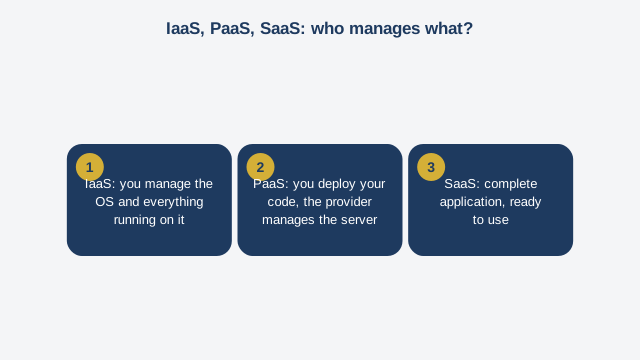
Welcome to this Cloud Computing and Network Architecture course. The final goal is easy to state and demanding to reach: deploy a modern cloud infrastructure that can grow with demand, is secure by default, and whose cost you control rather than simply endure. Let's start with the basic vocabulary you'll hear in every technical interview and every project meeting. Cloud computing is the ability to rent computing power — servers, storage, networking — from a provider, instead of buying and maintaining your own physical machines. Three providers dominate this global market: Amazon Web Services, often shortened to AWS, Google Cloud Platform, shortened to GCP, and Microsoft Azure. In this course, we'll use AWS as our running example, because it's the most widely used and best documented provider. But keep this in mind: the concepts you'll learn — virtual networks, compute, storage, managed databases — exist in almost identical form on Google Cloud Platform and Microsoft Azure, under different names. Learning AWS in depth is, in effect, learning cloud computing in general. There are also three service levels you must clearly distinguish. The first, Infrastructure as a Service, or IaaS, rents you raw building blocks: virtual servers, storage, networking. You manage the operating system and everything running on it yourself. The second, Platform as a Service, or PaaS, rents you a ready-to-use execution environment: you deploy your code, and the provider manages the underlying server. The third, Software as a Service, or SaaS, rents you a complete, ready-to-use application, like an online mail service. Take a concrete example: a logistics SME wants to host its delivery-tracking application. If it chooses IaaS, its technical team installs and maintains the server, the database, and security patches itself — full control, but a heavy workload. If it chooses PaaS, it simply deploys its code, and the provider handles the rest — less control, but a lighter technical team. This choice is never neutral: the higher you move toward SaaS, the less operational work you carry, but the less control you have and the more you depend on the provider. That tension between control, effort, and dependency is exactly what you'll learn to navigate throughout this course.
Free preview, no account needed — the rest of this module and the following modules unlock after enrolling.
Convinced? Enroll to unlock the full course.
See pricing