
Data Science & Machine Learning for Non-Engineers
Module 1 · Module 1 — What Machine Learning Actually Is · Lesson 1 of 1
What Machine Learning Actually Is
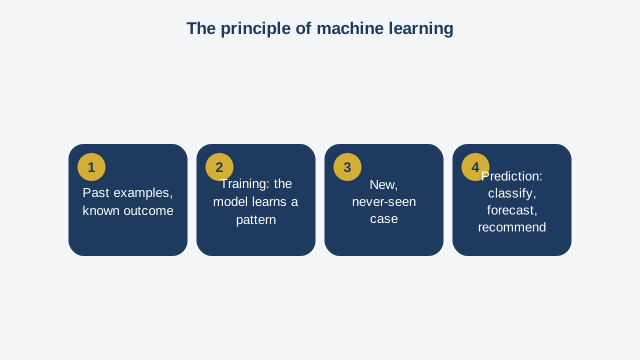
If you've taken the Data Analytics and Business Intelligence course, you already have the foundations this module builds on: you know how to recognize quality data, query a database with SQL, and clean a dataset with Python and pandas. We won't revisit those basics here — we'll build directly on top of them. This module's real question is different: what does machine learning — ML — actually add beyond classic data analysis? The difference comes down to one sentence: classic data analysis answers questions about the past — "how much did we sell last month" — while machine learning answers questions about the future or the unknown — "which customer is likely to switch to a competitor," "what's the fair price for this new product," "is this transaction likely fraudulent." Machine learning doesn't replace data analysis, it builds on it to go further: predicting, classifying, recommending. Concretely, a machine learning model learns a pattern from past examples, then applies that learned pattern to new cases it has never seen. Here's a simple image: a model predicting whether a customer will churn works a bit like an experienced salesperson who, after watching hundreds of customers leave or stay, develops an intuition for the warning signs of departure — late invoices, declining usage, calls to customer support. Machine learning turns that human intuition into a reproducible calculation, applied systematically to every customer rather than just the ones a salesperson happens to notice. That said, one common myth needs dispelling: machine learning isn't a magic box that guesses with no data. A model needs many past examples, with known outcomes, in order to learn — this is called training. Without a sufficient, relevant history, no model can learn anything useful, no matter how sophisticated the algorithm. Let's take two real cases to illustrate the difference between a successful and a failed machine learning use in a company. Successful case: a bank uses a credit-scoring model, trained on thousands of past files with known outcomes (repaid or defaulted), to prioritize human review of new loan applications — the model doesn't decide alone, it helps a human analyst focus on the most uncertain files. Failed case: a recruitment company tried to use a model to automatically screen job applications, trained on the company's past hiring decisions — the model ended up reproducing historical hiring biases, systematically screening out certain profiles, because its training data reflected human decisions that were themselves biased. This second case foreshadows a central theme of this course, covered in more depth in module 7: a machine learning model is never neutral. It faithfully reproduces the patterns present in its training data — including when those patterns are biases you'd rather not reproduce.
Free preview, no account needed — the rest of this module and the following modules unlock after enrolling.
Convinced? Enroll to unlock the full course.
See pricing