Mobile Development in the Age of AI (Android + iOS)
Module 1 · Choosing an Approach (Native vs. Cross-Platform) · Lesson 1 of 1
Choosing Your Approach (Native vs. Cross-Platform)
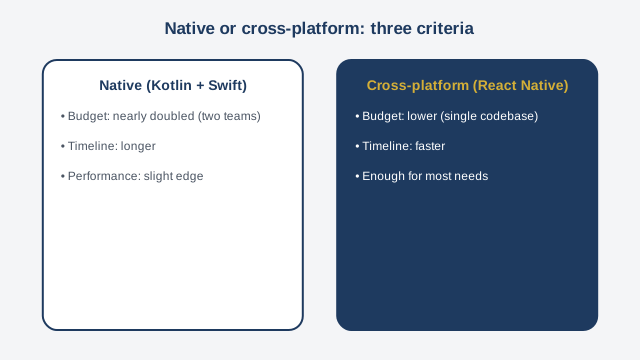
Welcome to the first module of Mobile Development in the Age of AI. Before writing a single line of code, there's one decision that shapes everything that follows: how are we going to build this app? There are two main approaches. The first is called native development. That means writing one application specifically for Android, using the Kotlin language, and a completely separate application specifically for i o s, using the Swift language. Two different codebases, for the same app idea. The second approach is called cross-platform development. Here, you write a single codebase, in a single language, and that codebase is automatically turned into both an Android app and an i o s app. The two most widely used frameworks for this approach today are React Native and Flutter. In this course, we'll go deep on React Native, because it's built on JavaScript, a language many of you already know if you're coming from web development. So, how do you choose between the two? Three main criteria. First criterion: budget. Native development usually costs almost twice as much, because you need two teams, or a single developer who has to master two different ecosystems. Cross-platform, with a single codebase, cuts that cost significantly. Second criterion: timeline. For the same reasons, a cross-platform project generally ships faster than an equivalent native project, especially if the app needs to launch on both platforms at the same time. Third criterion: performance and access to the phone's most advanced features. Native still holds a slight edge here. If you're building a computation-heavy video game, or an app that uses very specific phone sensors, native can sometimes be the better option. But for the vast majority of business, commerce, and service apps — which make up most of the needs of small and medium businesses in West Africa — cross-platform is more than sufficient, and often preferable. There's a fourth point, less technical but very important on the ground: developer availability. Whether you're hiring or specializing yourself, there are today far more cross-platform developers available locally than specialists who cover both native platforms at once. A word now on artificial intelligence — AI — in this decision. AI coding assistants like Copilot, or conversational AI tools, can help you quickly generate React Native or Flutter code, fix errors, or explain a cryptic error message. But be careful: an AI doesn't know the real constraints of your project — your budget, your timeline, your client. The strategic choice between native and cross-platform must remain a human decision, grounded in the criteria we just covered. AI is an execution accelerator, not a decision-maker. To sum up this module: always ask yourself three questions before choosing your approach. What budget is available? What timeline is expected? And does the app have very specific performance or sensor needs that justify going native? In most of the cases you'll encounter in West Africa, the answer will be cross-platform, specifically React Native, which we'll use throughout this course.
Free preview, no account needed — the rest of this module and the following modules unlock after enrolling.
Convinced? Enroll to unlock the full course.
See pricing