DevOps in the Age of Artificial Intelligence
Module 1 · Module 1 — DevOps Culture and Principles · Lesson 1 of 1
DevOps Culture and Principles
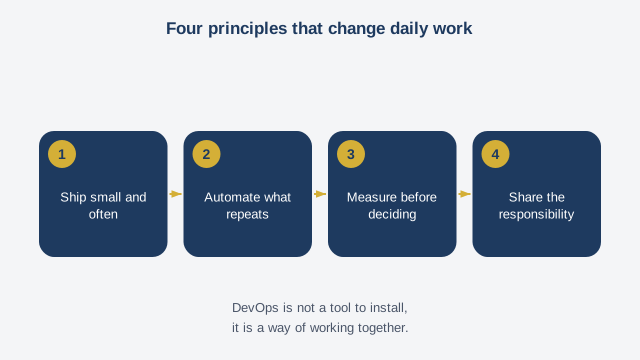
Welcome to this course on DevOps in the Age of Artificial Intelligence. Before talking about tools, you need to understand what DevOps actually is, because that's the number one misunderstanding among teams whose transformation fails. DevOps is a blend of two English words, Development and Operations. Historically, these two worlds lived apart, almost like two different companies under one roof. The development team wrote code and shipped it. The operations team picked up that code and had to run it in production, often without having taken part in the decisions that shaped it. When something broke in production, each team pointed at the other: "it worked on my machine" versus "you shipped us a mess." This informal wall between development and operations is called a silo. DevOps is not primarily a toolbox. It's a culture of shared responsibility: developers understand production constraints, operations staff take part in design decisions, and everyone is accountable for the end result, not just their own task. One principle sums up this mindset well: whoever builds a service is also the one who runs it in production and who answers when it breaks. Let's take a concrete case. Picture the technical team at Golfe Telecom, a fictional telecom operator based in Rabat, historically split into two distinct departments: development on one side, infrastructure on the other, with a ticket to fill out for every release, processed only once a week. Releases are stressful, often happen overnight, and nearly forty percent of them have to be rolled back because of a problem discovered too late. This team's DevOps transformation didn't start with buying a new tool. It started with joint meetings between developers and operations staff, a reliability goal shared by both camps, and only then with the gradual automation of repetitive steps. Remember this: a company that installs automation tools without changing its culture of shared responsibility rarely gets good results. The tool speeds up a process; it doesn't repair a broken relationship between teams. That is exactly what you'll analyze in the case study that follows.
Free preview, no account needed — the rest of this module and the following modules unlock after enrolling.
Convinced? Enroll to unlock the full course.
See pricing