
Project Management & Agile Methods
Module 1 · Module 1 — Project Management Fundamentals · Lesson 1 of 1
Project Management Fundamentals
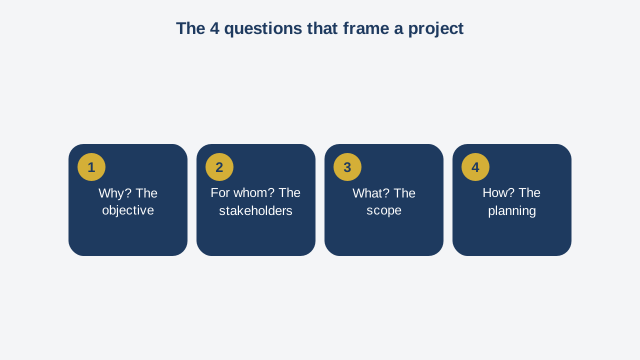
A project is not a task. It's a temporary set of actions, with a start and an end, that mobilizes human and financial resources to reach a specific goal. A recurring task like monthly invoicing is not a project. Launching a new mobile app, organizing an event, or digitizing an SME's order process — those are projects. Why do so many projects fail, even with a skilled and motivated team? The answer is rarely a lack of talent. It's almost always a lack of scoping at the start. Take a concrete case. A food distribution SME decides to digitize how it manages supplier orders. The owner tells the team: "we need a tool to track orders." The team jumps in, picks a tool, starts configuring it. Three weeks later, they discover the sales department assumed it would also track customers, not just suppliers. The budget planned for a simple tool doesn't cover that extra scope. The project stalls, the money already spent is wasted, and the team's trust in future digital projects takes a hit. This project didn't fail because of a bad tool. It failed because nobody clarified, before starting, three essential questions: what exactly is the objective, what is the scope — meaning what's included and what isn't — and who are the stakeholders, meaning everyone affected by the outcome or able to influence the project. Project management, in its simplest form, answers four questions in order. Why are we doing this project — that's the objective. For whom — that's the stakeholders and end users. What exactly — that's the scope. And finally, how and with what resources — that's the planning. Historically, project management first developed around a "waterfall" approach: plan everything up front, in a strict sequence, and execute step by step without going back. This works well when the final result is perfectly known from day one — building a bridge, for instance. But for digital projects, where requirements often evolve along the way, it quickly shows its limits: you discover too late that a feature doesn't match the actual need. That's what gave rise to the agile approach, which we'll cover in detail in the next module. But before we get there, remember this: whichever method you choose next — waterfall or agile — no method compensates for poor initial scoping. A well-scoped project run with a simple method succeeds more often than a poorly scoped project run with the most sophisticated method on the market. Three roles show up in almost every project, regardless of size. The sponsor, who owns the budget and the final decision. The project manager, who coordinates day-to-day execution. And the team, who does the work. In a small organization, one person may wear several of these hats — but you need to stay aware of which hat you're wearing at any given moment. Remember one figure: according to several international project management studies, roughly seventy percent of projects that fail do so for reasons tied to initial scoping and communication, not purely technical problems. That's why this module opens the course, before we even talk about tools or methods.
Free preview, no account needed — the rest of this module and the following modules unlock after enrolling.
Convinced? Enroll to unlock the full course.
See pricing