Growth Marketing, SEO & Data-Driven Acquisition
Module 1 · Module 1 — The Acquisition Funnel · Lesson 1 of 1
Tracking a visitor from first visit to loyal customer
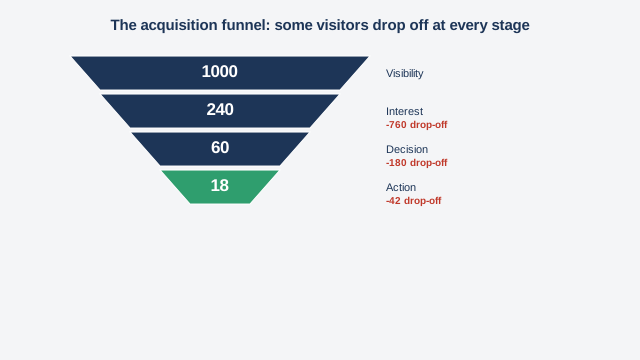
Before learning how to attract more customers, you need to understand why most visitors who discover a business online never buy anything. It's almost never because the product is bad. It's because between discovery and purchase, there are several stages, and at each stage, some visitors drop off. This multi-stage journey is called the acquisition funnel — shaped exactly like the word suggests: wide at the top, narrower and narrower as you move down. The classic funnel has four stages. The first stage is visibility: the moment someone discovers the business exists, through a Google search, a social media post, or a recommendation. At this point, the person isn't actively looking to buy yet — they're becoming aware of a possibility. The second stage is interest: the person visits the site, reads a full post, asks a question. They show an engagement signal, but aren't ready to buy yet — they're comparing, hesitating, needing reassurance. The third stage is decision: the person seriously compares options, checks reviews, asks for a quote or a precise price. This is the stage where objections need to be addressed — price, trust, delivery time. The fourth stage is action: the purchase, the sign-up, the booking — the final goal. The value of breaking the customer journey into four precise stages, rather than vaguely talking about "attracting customers," is that each stage calls for a different action and a different metric. A business with lots of visibility — lots of views, lots of followers — but very few actions doesn't have a visibility problem, it has a conversion problem at the later stages. Investing more in visibility, in that case, solves nothing: it's like pouring more water into an already leaking funnel. This is exactly what growth marketing brings to the table, which we'll distinguish from traditional marketing in module three: instead of focusing solely on the funnel's first stage — which is often what traditional advertising does — growth marketing looks at the whole funnel and systematically looks for the biggest leak, to concentrate effort where it has the most impact. A funnel is easy to sketch on paper: four stacked boxes, each with a number of people or a percentage. That's the visualization exercise you'll now practice.
Free preview, no account needed — the rest of this module and the following modules unlock after enrolling.
Convinced? Enroll to unlock the full course.
See pricing