
Advanced Prompt Engineering for Professionals (Claude, GPT, Gemini)
Module 1 · Module 1 — Beyond the Basics: Structuring Complex Prompts · Lesson 1 of 1
Beyond the Basics: Structuring Complex Prompts
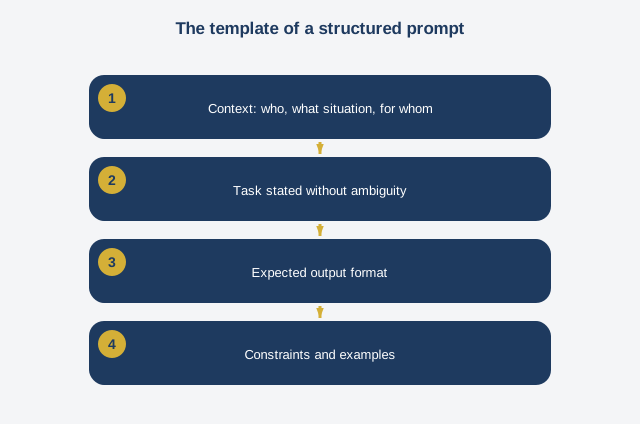
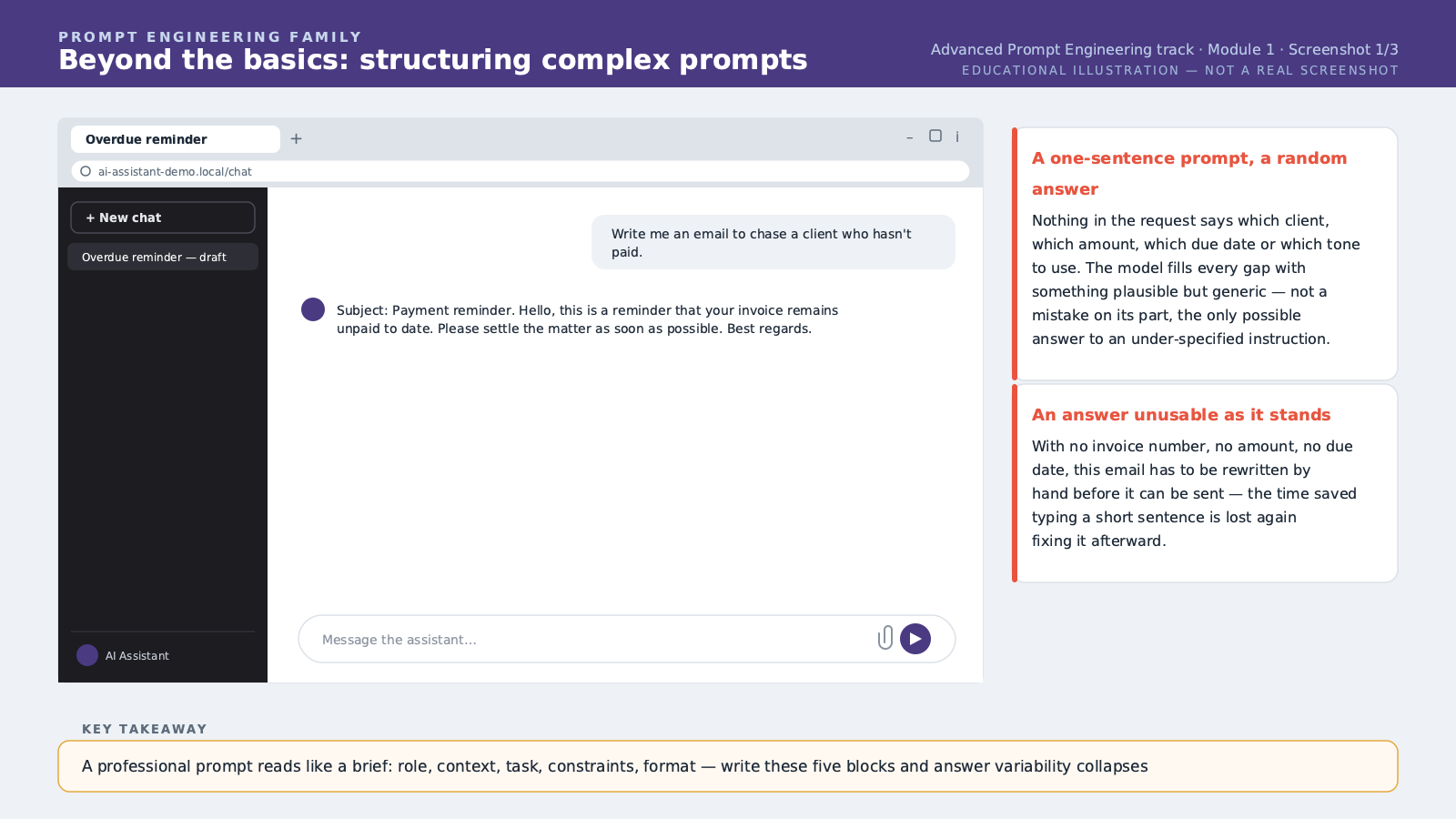
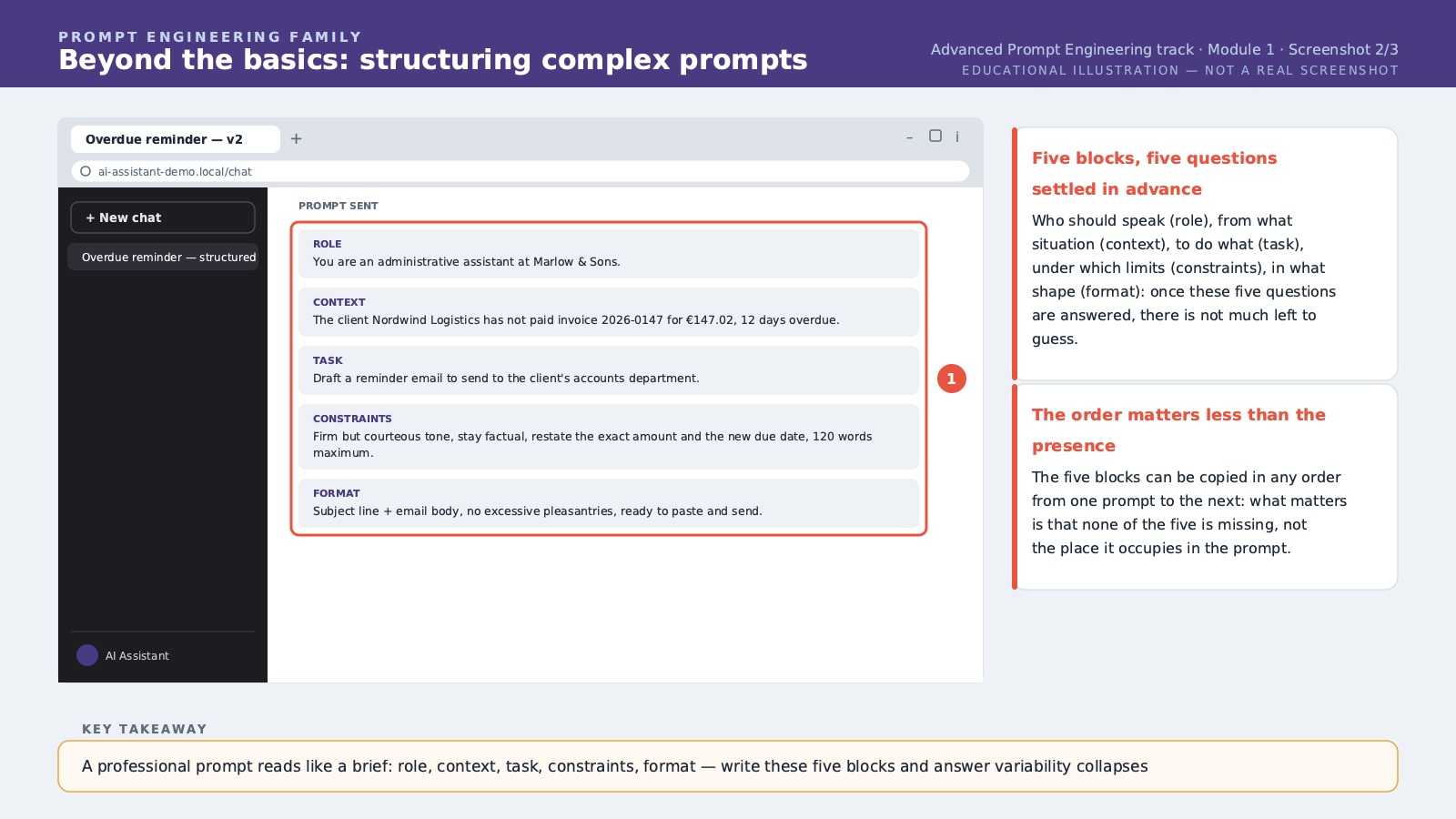
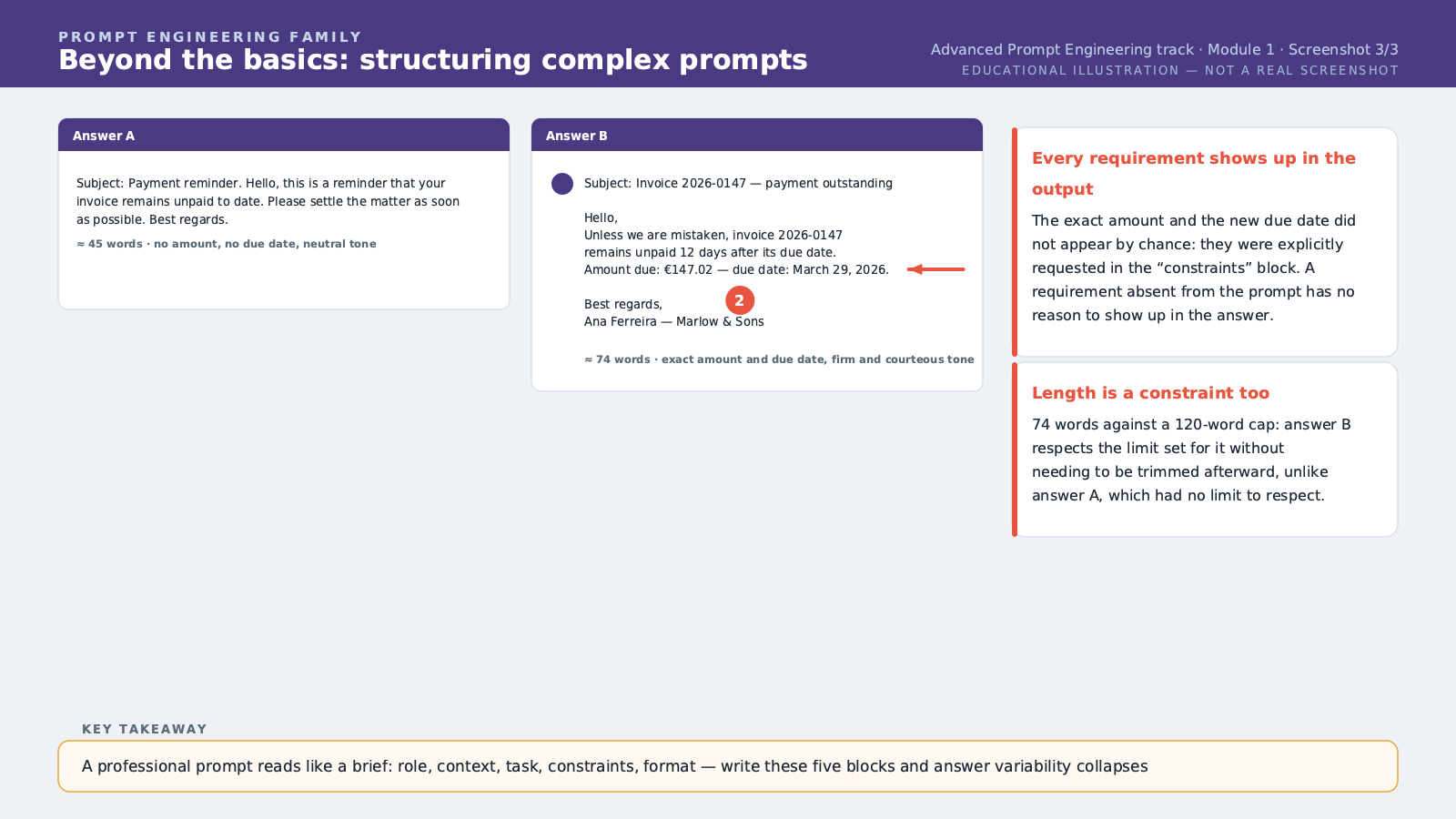
If you already use AI daily, you've probably noticed something frustrating: the same question, asked twice, sometimes produces two very different results in quality. This is almost never a problem with the model. It's a problem of structure. A poorly structured prompt works like a rushed verbal instruction given to a new colleague: they guess what you want, fill in the gaps with their own assumptions, and hand you something plausible but not necessarily correct. A well-structured prompt, by contrast, works like a complete professional brief: the colleague knows exactly what's expected, in what context, and in what form. A well-structured professional prompt contains, in this order, four elements. First, context. Before asking for anything, give the AI the background information a human would need to do the job well: who you are, what situation you're in, and who the work is for. Without context, the AI picks a default context for you — usually the most generic one, rarely the right one. Second, the task itself, stated without ambiguity. "Help me with this contract" is not a task, it's an intention. "Review this non-compete clause and flag any wording that could be considered disproportionate under labor law" is a task. Third, the expected output format. A professional who asks you for a report never simply says "write me a report" — they specify the length, the structure, sometimes even the tone. Do the same with AI: specify whether you want a list, a table, a single paragraph, two hundred words, or two thousand. Fourth, constraints and examples. This is the most commonly forgotten element, and yet the most powerful. If you have an example of what you definitely don't want, show it. If a constraint is non-negotiable — a budget, a regulation, a deadline — state it explicitly rather than assuming the AI will guess it. Let's take a concrete example. A weak prompt would look like this: "Write me an email to follow up with a client who hasn't paid." A structured prompt would look like this: "You are a sales assistant for a digital services SME in Europe. Draft a follow-up email for an invoice that has been unpaid for thirty days, to an otherwise loyal client with whom the relationship needs to stay cordial. The tone should be firm but respectful, with no explicit threat of legal action at this stage. Maximum length: one hundred fifty words. End with a concrete proposal for a payment schedule." The difference in output between these two prompts isn't cosmetic. The second one saves you editing time, reduces the risk of an inappropriate tone, and produces a text you can send with minimal touch-ups. One last thing before the exercise: structuring a prompt doesn't mean making it unnecessarily long. A well-structured five-line prompt always beats a thirty-line prompt that stacks information with no hierarchy. Structure is about order and clarity, not volume.
Free preview, no account needed — the rest of this module and the following modules unlock after enrolling.
Convinced? Enroll to unlock the full course.
See pricing