
Create a Video Ad from Scratch with AI
Module 1 · Anatomy of a video ad that converts · Lesson 1 of 1
The ingredients of an AI video ad that actually converts
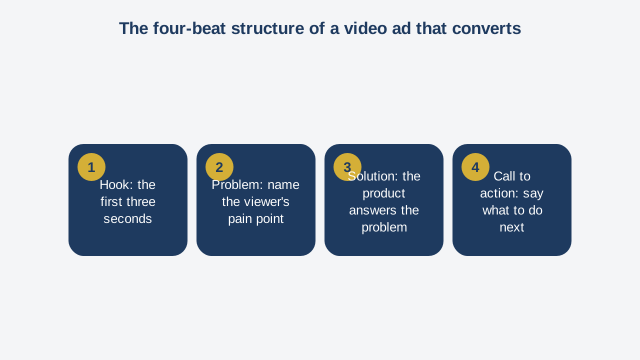
Welcome to this Create a Video Ad from Scratch with AI course. Before touching a single generation tool, you need to understand what separates a video ad that grabs attention and sells from a video that's merely pretty and that nobody watches to the end. A video ad that converts almost always follows the same four-beat architecture. First, the hook: the first three seconds, not one more, during which the viewer decides to stay or scroll past. An effective hook creates immediate tension — a direct question, an unexpected image, a problem the viewer instantly recognizes. Next, the problem: you clearly name the pain or the need, so the viewer thinks "that's exactly my situation." Third, the solution: the product or service enters, presented as the direct answer to the stated problem, not as a list of technical features. Finally, the call to action, or CTA, which says precisely what to do next: order, sign up, message on WhatsApp. Pacing matters as much as structure. A thirty-second ad that holds the same shot for ten seconds loses a large share of its audience before the end. The rule of thumb to remember: a shot change, on-screen text change, or sound-rhythm change roughly every two to three seconds, to hold attention on a format built for fast scrolling. Take a concrete example. A clothing brand in Cape Town selling online builds a twenty-five-second ad. The first three seconds show someone hesitating in front of their wardrobe, with on-screen text: "Nothing to wear again this morning?" — that's the hook. The next five seconds name the problem: finding quality clothes, delivered fast, without going into town. The next fifteen seconds show the solution: the catalog scrolling by, ordering in three steps, same-day delivery in Cape Town. The last two seconds show the CTA: "Order on WhatsApp, delivered today." A second ad, for an online training service in Abidjan, follows the exact same architecture with a different tone. The hook relies on a striking number read aloud. The problem is named in a single sentence. The solution is demonstrated through a few seconds of video testimonial rather than a sales pitch. The CTA points to a free sign-up, with one precise word — "free" — that lowers the friction of the decision. What these two examples share isn't tone or visual style, but the invisible structure holding them up: hook, problem, solution, call to action, at a pace that never lets a single shot overstay its welcome. That structure is what you'll learn to spot in any ad, then build yourself starting in the next module.
Free preview, no account needed — the rest of this module and the following modules unlock after enrolling.
Convinced? Enroll to unlock the full course.
See pricing