
Information Systems Security for Public Institutions and Media
Module 1 · Module 1 — Specific security challenges · Lesson 1 of 1
Specific security challenges
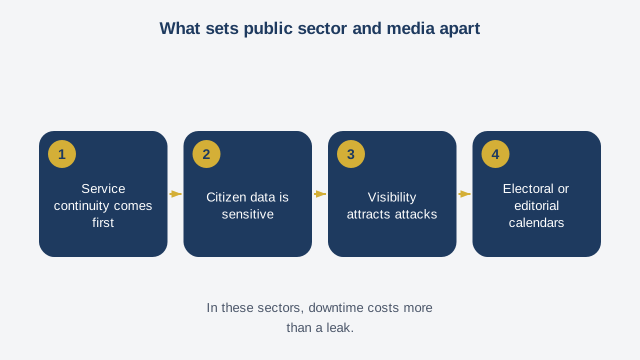
Welcome to this course on information systems security — IS — for public institutions and media organizations. In this first module, we lay the groundwork: why the information security of a government office or a broadcasting company looks nothing like that of a bank or a tech startup. A public institution handles data that directly affects citizens: civil records, tax files, health data. A media organization manages a different but equally sensitive resource: the public's trust in the information it broadcasts. Both types of organizations share a rare trait: when their security is breached, the impact goes far beyond the organization itself and lands directly on the population. Take a realistic example from a West African context. A town hall runs civil-records software on a local server that hasn't been updated in two years. A staff member clicks a booby-trapped email attachment. Within hours, the birth-records database is encrypted by ransomware — malicious software that locks files until a ransom is paid. The result: birth certificates cannot be issued for three weeks, citizens are stuck mid-process on administrative tasks, and public trust in the administration takes a lasting hit. This scenario illustrates three challenges specific to this sector, which we will explore throughout the course. First challenge: service continuity. A private company hit by an IT outage loses revenue. A public administration hit by the same outage prevents citizens from exercising their rights. Second challenge: political and social sensitivity. A hacked media outlet can have its accounts used to spread false information, with the potential for large-scale panic or manipulation — precisely because of the credibility the public normally grants that source. Third challenge: often limited resources. Unlike a large bank, a local administration or a small TV station rarely has a full-time dedicated security team. Security must therefore be designed around constrained resources, not an unlimited budget. In the modules ahead, we will cover protecting personal data, securing broadcast infrastructure, managing access rights, facing cyberthreats that specifically target media, preparing a business continuity plan, and raising staff awareness — staff being, as we will see, the weak point attackers exploit most often. Keep this core idea from the module: in this sector, security isn't measured only in financial losses avoided, but in public trust preserved.
Free preview, no account needed — the rest of this module and the following modules unlock after enrolling.
Convinced? Enroll to unlock the full course.
See pricing