AI Voice & Professional Audio Production
Module 1 · Overview of AI voice technologies · Lesson 1 of 1
The landscape of AI voice technologies
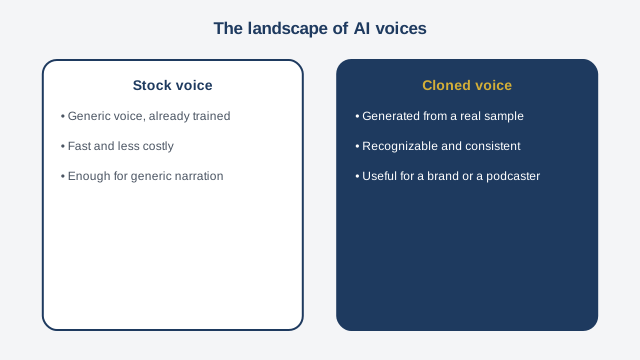
Welcome to this AI Voice and Professional Audio Production course. Before cloning anything, you need to understand the landscape of AI voice technologies, because that landscape has changed enormously in recent years, and because the right tool choice depends entirely on what you're trying to produce. The base technology is called speech synthesis, or TTS — Text-to-Speech. The principle: you give written text to a piece of software, and it produces an audio file where a fully generated voice reads that text aloud. There are two broad categories of TTS voices. First, so-called stock or library voices: generic voices, already trained by the provider, that anyone can use, in different languages and styles — a deep male voice for a documentary, a dynamic female voice for an ad. Second, cloned voices, the subject of the next module: a voice generated from an audio sample of a real person, yours or a client's, reproducing their own vocal characteristics. The choice between a stock voice and a cloned voice depends on the need. For generic training narration, a good, well-directed stock voice is often more than enough, and usually costs less production time. For a brand ad wanting a recognizable, consistent voice across months of campaigns, or for a podcaster wanting to keep their own voice while producing faster, cloning becomes relevant. Beyond this basic distinction, several quality criteria let you compare AI voices against each other. Naturalness of intonation first: a good modern AI voice varies its pace and pitch the way a real speaker would, rather than reciting every word flatly and mechanically. Handling of pauses and breathing next: a voice that never breathes and strings sentences together with no pause at all sounds instantly artificial. The ability to interpret an emotion or a tone — a topic covered in depth in module three. And finally, support for the target language and accent: not every AI voice handles West African French equally well, with its own intonations, distinct from France French. Take a concrete example: a vocational training center in Lomé wants to produce audio narration for ten online course modules. The team tests three different AI voices on the same introductory paragraph: a generic international-French stock voice, a stock voice with an accent closer to West African French, and a voice cloned from the center's lead trainer. Listening to all three versions back to back, the team evaluates each on the same criteria — naturalness, pause handling, clarity of technical-term pronunciation — before choosing which one to use for all ten modules, rather than trusting a first impression from a single clip. Keep this principle for the rest of the course: there is no single best AI voice in the abstract, only a voice best suited to a given content, audience, and budget. That comparative evaluation is exactly what you'll practice in the exercise that follows.
Free preview, no account needed — the rest of this module and the following modules unlock after enrolling.
Convinced? Enroll to unlock the full course.
See pricing