
Digitalizing Your Business's Services
Module 1 · Module 1 — Mapping Your Current Internal Processes · Lesson 1 of 1
Mapping out what actually happens before digitizing anything
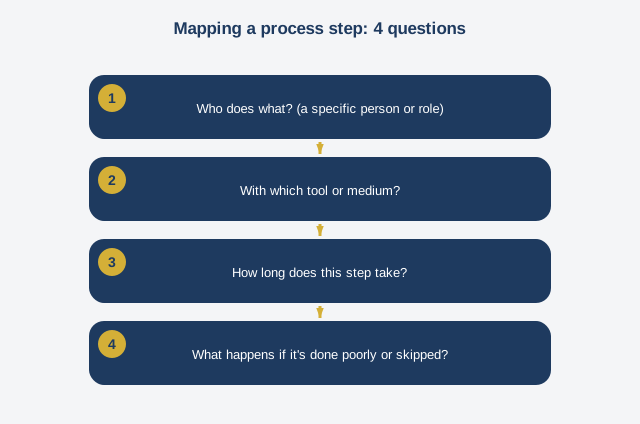
Many business owners want to digitalize a process before even knowing precisely how that process works today. That's a costly mistake: you can't improve, let alone automate, something you've never formally described. This first module teaches process mapping — a simple method for making visible what, in a business, is often done "from memory" or "as usual," with no one ever having written down the exact sequence of steps. A process, in the sense used in this module, is a sequence of steps repeated regularly to produce a specific result — processing an order, hiring an employee, issuing an invoice, responding to a customer complaint. Mapping a process means answering four questions, in this order, for every identified step. First question: who does what? Each step must be tied to a specific person or role, not a vague "someone handles it." Second question: with what tool or medium? A paper notebook, an Excel file, an app, a simple phone call — every step uses some medium, often a different one from step to step, which creates friction points whenever information has to move between mediums. Third question: how long does this step take? An estimate is enough at this stage, not a stopwatch measurement — the goal is to spot abnormally long steps. Fourth question: what happens if this step is done poorly or skipped? This question reveals the process's fragile points — the steps whose failure has the biggest consequences. Once these four questions are answered for every step, you get a simple map, usually shown as a chronological list or a diagram with arrows connecting each step to the next. This map almost always reveals surprises, even to an owner who thinks they know their business well: redundant steps, information handoffs that get lost between two people, tasks that take far longer than expected. An important methodological point: the map must describe the process as it actually happens today, imperfections included — not the ideal process as it should work on paper. Describing an idealized rather than a real process makes the rest of the approach useless, because the following modules in this course build directly on the friction points identified in this first, honest map. This map isn't an end in itself: it's the foundation for the next module, which teaches how to identify, among all the mapped processes, which ones to prioritize for digitalization.
Free preview, no account needed — the rest of this module and the following modules unlock after enrolling.
Convinced? Enroll to unlock the full course.
See pricing